
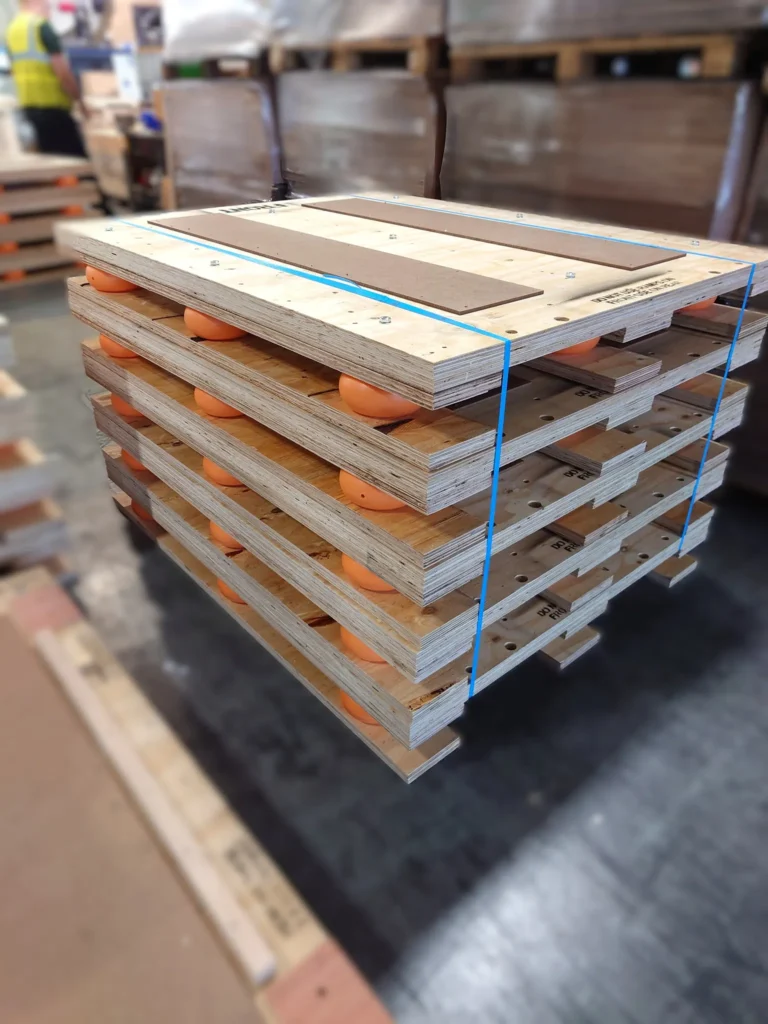
APS Packaging designs and builds shock pallets at our 300,000 sq ft site in Bideford, Devon. A shock pallet is a timber pallet with a layer of shock-absorbing isolators between the deck and the base, so the jolts of forklifts, tail-lifts, potholes and loading docks are soaked up before they reach the equipment.
The isolators only work when they carry the right weight, so we do not sell a standard size off a list. We work from your weight, footprint and fixing points, count and place the isolators for that load, and build the pallet to match, heat treated to ISPM 15 when it is going abroad. One-off, or as a weekly programme.
Last reviewed 30 October 2026
Email our Sales Team : sales@apspackaging.co.uk
Or simply use the form below to pop us a message or request a call back.
Anything heavy enough to hurt itself and delicate enough to fail after a knock.
Populated and empty 42U and 47U racks, bolted down through the rack's own transport points, on a pallet alone or inside a crate.
Floor-standing enclosures and control cabinets, built as a repeat programme so every pallet in the run is the same.
Benchtop and floor-standing test machines whose calibration or electronics suffer from shock in transit.
Equipment where a single drop can knock optics out of alignment or cause early electronic failures.
Tall, top-heavy cabinets that need a wide, stable base as well as isolation.
Shock pallets for export are built from heat-treated timber and stamped under our own ISPM 15 registration, FC0542.
Every shock pallet has three layers. The isolators in the middle do the work; the deck and the base make sure the load reaches them evenly and the pallet can still be handled like any other.
| Layer | What it is | Why it matters |
|---|---|---|
| Deck | One or two layers of plywood, with a timber perimeter or locating strips for the item's feet | Spreads the load across every isolator and gives the bolts something solid to grip |
| Isolators | Polyethylene foam blocks or moulded cushion isolators, counted and spaced for the load | Compress under a shock and recover, so the peak force on the equipment is cut |
| Base | Timber runners or legs, two-way or four-way fork entry | Keeps the isolators off the floor and lets the pallet be lifted from the side you need |
| Tethers | Steel bolts through each isolator into a captive T-nut, with clearance so the deck can move | Stops the deck parting from the base if the pallet is tipped, without short-circuiting the foam |
| Fixings | Bolt-down points drilled to your rack or cabinet's transport holes | Holds the item to the deck so it moves with the isolators, not against them |
Every pallet is drawn for its load, but most fall into one of these bands. Send us the weight and footprint and we will tell you which one fits, or design outside them.
| Load on the pallet | Typical isolators | Deck | Height added over a standard pallet | Typical use |
|---|---|---|---|---|
| 50 to 300 kg | 4 to 6 polyethylene foam blocks | Single or double 18 mm ply | About 40 to 90 mm | Instruments, test machines, small cabinets |
| 300 to 700 kg | 8 or 9 moulded cushion isolators on three legs | Double 15 mm ply | About 120 to 140 mm | Populated server racks, enclosures |
| 700 kg and over | Isolator count and grade worked out for the load | Double ply on a timber frame | Designed to the job | Switchgear, UPS and battery cabinets |
Figures are typical of pallets we have built, not a limit. The isolator count always comes from the weight each one carries, so the same footprint can need a different build at a different load.
| Option | What you get | Best for |
|---|---|---|
| Shock pallet alone | Isolated deck with bolt-down points, the item stretch-wrapped or covered | UK road delivery on a dedicated or tail-lift vehicle, items that are unwrapped on arrival |
| Crate on a shock pallet | The same pallet with a crate standing on the deck, removable front for loading, the crate moving with the item | Export, groupage and air freight, or anywhere the item will be stacked against or handled by strangers |
| Foam-lined crate | A crate lined on every face with foam, no separate isolators | Smaller, lighter items up to around 100 kg |
For racks and cabinets going in a crate, see server rack crates.
A manufacturer of electrical and IT enclosures needed its cabinets to reach data centres and building sites without damage. We designed a shock pallet for each footprint in their range, bolted to the cabinets' own transport points, and now build them as a weekly programme. Each pallet in a run is cut on CNC from the same drawing, heat treated to ISPM 15 and delivered on our own fleet, so the hundredth pallet is the same as the first.
Not sure how much protection you need? Read our guide, what is a shock pallet and when do you need one?
APS Packaging Ltd
Designs our shock pallet and crate specifications, from the isolator count to the bolt pattern, and wrote our guides on shock protection and ISPM 15.
Sales and Commercial Manager, APS Packaging Ltd
Looks after our customer accounts: repeat orders, delivery dates, commercial terms and changes to a spec as your needs change.
How isolation works, when you need it, and how a shock pallet is sized.
Crates built around racks and cabinets on a shock pallet base.
What heat treatment and the FC0542 mark mean for wood packaging going abroad.
Foam, cardboard and timber combined for items that need more than a pallet.
A pallet with a layer of shock-absorbing isolators between the deck the equipment stands on and the base the forklift lifts. The isolators compress when the pallet is jolted and recover afterwards, so less of the shock reaches the equipment.
Server racks and IT cabinets, electrical enclosures, switchgear, test and laboratory instruments, and medical, laser and optical equipment. Anything heavy and fragile that is moved by forklift, tail-lift or freight.
No, because the isolators only work at the right load. The same footprint can need a different number of isolators at a different weight. We design each pallet from your weight, footprint and fixing points, then build it the same way every time you reorder.
Yes. We build crates that stand on the shock pallet deck, so the crate moves with the item and the isolators protect both. See server rack crates.
Yes. Shock pallets going abroad are built from heat-treated timber and stamped under our own ISPM 15 registration, FC0542, so they clear plant-health checks at the border.
Send us the weight, footprint, fixing points, route and quantity, ideally with a photo or drawing. Call 01237 423772 or email sales@apspackaging.co.uk.
Our shock pallets are precision engineered to absorb vibration and impact, protecting fragile, sensitive and high-value equipment during transport and handling. Designed around your specific load at our Bideford facility and available ISPM15 certified for export.
Shock pallets are specified where standard packaging can’t protect sensitive cargo: defence and military equipment, avionics, precision instruments and high-value electronics. We combine engineered timber platforms with foam or moulded cushion isolators matched to your equipment’s weight and fragility rating, attenuating shock and vibration through handling, road, sea and air transit. Every design is bespoke: tell us the load, the route and the standard it needs to meet, and we’ll engineer the pallet around it.
Custom footprints, heavy-duty decks and machinery skids.
Designed around your product, one-off or production run.
The complete export service, from design to delivery.
Standard & bespoke pallets to spec.
Bespoke crates for high-value goods.
ISPM15 packaging for international shipping.
Timber & board combined for protection.
Manufactured in Devon, delivered across the South West on our own fleet, and nationwide for export.
Serving Bath, Taunton, Bridgwater and Truroplus every town across the South WestDelivered UK-wide.
Email our Sales Team : sales@apspackaging.co.uk
Send us a Message or Request a call back. Enter your details and we’ll be in touch.