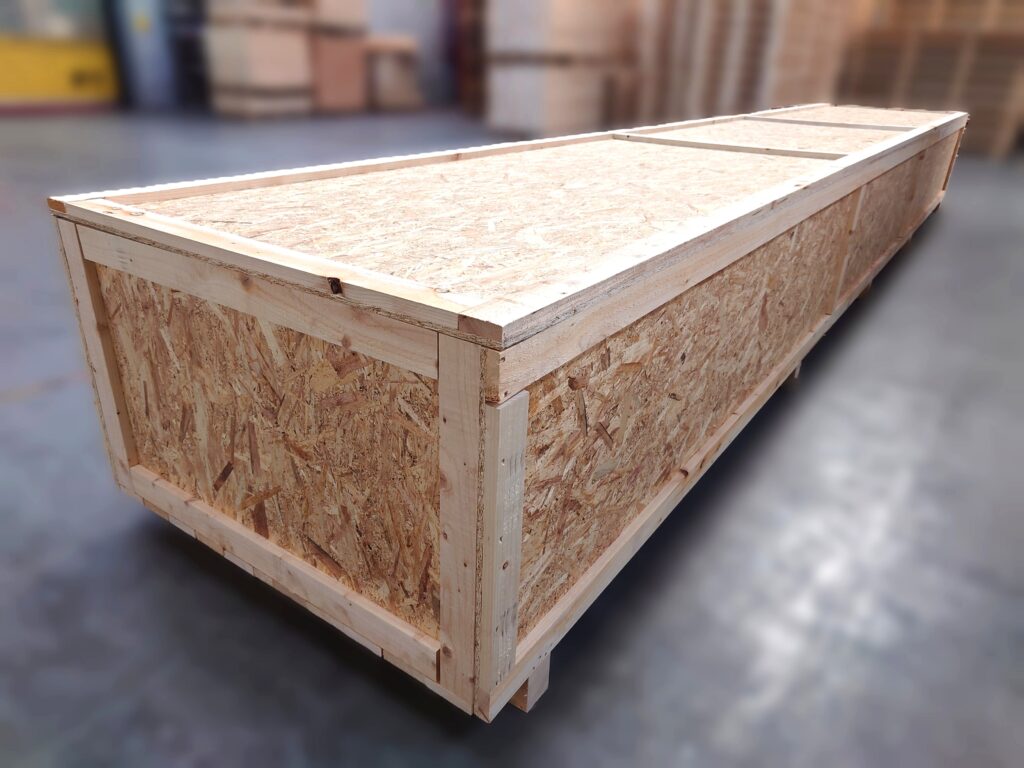
Most of the crates built at Bideford are the same design in different sizes: 11 mm OSB clad over a 22 x 100 mm timber picture frame, on a bearer base, with a battened OSB lid. We call it a framed OSB crate. This is why it is our standard, and when we build something else.
The frame carries the load
OSB is a sheet material, not a structure. The picture frame is the structure. The 22 x 100 rails and uprights take the load from the lid down into the base, and the OSB stiffens the frame and closes the box. The frame is fixed on the outside, so the inside faces are flat and the internal size is exactly what was ordered. A crate ordered at 1200 x 800 x 900 internal is 1200 x 800 x 900 internal.
The base matters as much as the walls. The bearers stand on edge, which gives deep fork pockets that a forklift driver can see. The walls sit over the bearers rather than on the floor overhang, so when the crate is lifted the load goes into the bearers instead of trying to pull the floor off. That detail is the difference between a crate that survives transhipment and one that arrives with the floor hanging out.
Why framed OSB rather than plywood or solid boards
Cost, mostly. OSB is the cheapest rigid sheet that takes a nail and a knock, and for most freight, in the UK or for export, it does the job. That leaves more of the budget for the internal packing, which is where the product is actually protected.
Plywood earns its premium in three cases: when the crate will be handled many times, when it may stand outside, and when the customer will see it. It takes an impact without splitting, sheds water better and looks the part when a lid comes off in front of a customer. Solid, close-boarded timber is for heavy loads, where the crate is really a machine base with walls.
If a customer asks for plywood and OSB would do, we say so. If they ask for OSB and the load needs timber, we say that too.
Export
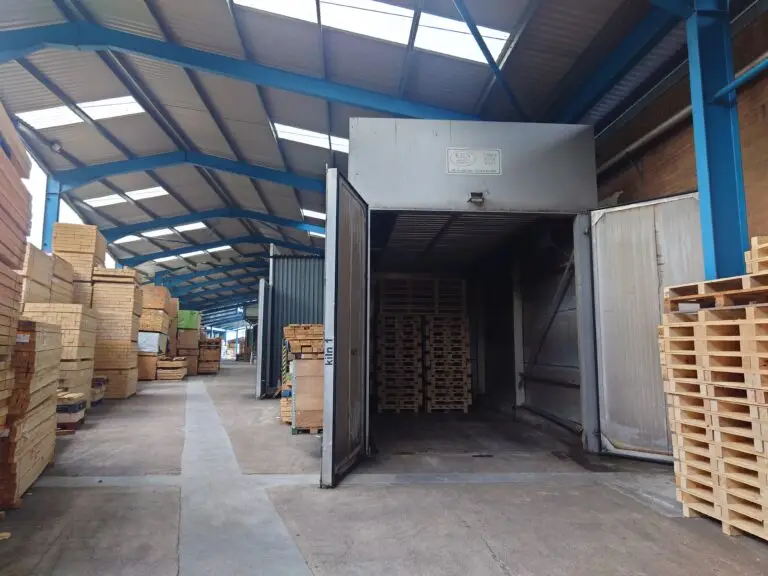
ISPM 15 applies to solid wood. OSB is a processed wood product and is exempt, but the timber frame and base are not. Crate timber comes in kiln dried and heat treated, so a framed crate does not have to go through a kiln here, and the finished crate is stamped with our FC0542 mark under our own registration. That makes the whole crate compliant for the EU and the rest of the world. The UK rules are in the government guidance on wood packaging. Our own two kilns run 24 hours a day for pallets and for anything that needs treating on site.
Flat-pack, returnable, lined
The same crate screws together as easily as it nails, so we build knock-down versions with bagged fixings for customers who want to assemble around the product on site, or send the crate back for another trip. Foam, cradles, chocks and dividers are cut to the product and fitted here. Barrier bags, VCI film and desiccant go in when the route is by sea.
When to ask for something else
Ask for plywood when appearance, weather or repeated handling matter. Ask for a riveted plywood case when weight matters and every panel fits within a 2440 x 1220 sheet. Ask for close-boarded timber when the load runs to tonnes. Ask for slatted when the contents need air. Or send us the size, the weight and the destination and we will tell you which.
More on our framed OSB crates, plywood crates, export crates and bespoke wooden crates, and on ISPM 15 heat treatment.